1. Leadership
The PIDF acknowledges that inclusive and stewardship leadership is a critical part of transforming the green – blue economies with thriving societies. While political leadership will take the lead, its is essential that leadership in the private sector and civil society (including women, youth, people with disabilities) including religious and traditional, are included and play their roles in the decision making process.
2. Role of Healthy People
Healthy and happy Pacific people are the first requirement for sustainable development. A ‘whole society’ approach must be implemented to ensure significant action on the prevention and control of NCDs, promotion of maternal, child and adolescent health and the creation of public – private sector partnership.
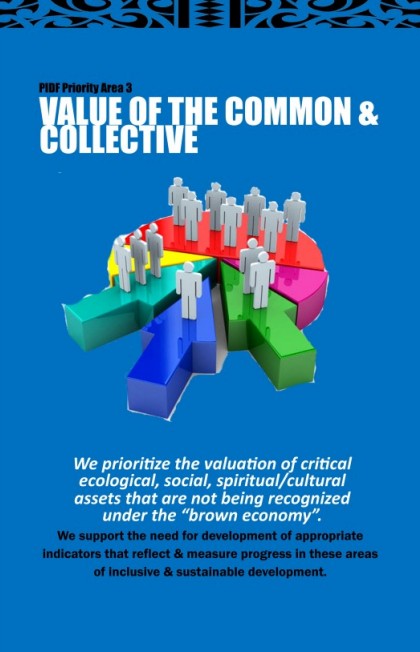
3. Value of the Pacific common
and collective
We prioritize the valuation of critical ecological, social, spiritual/cultural assets that are being recognized under the ‘brown economy’; and for the development of appropriate development indicators that reflect and measure progress in these areas of inclusive and sustainable development.
4. Long term financing/trust funds – support to communities
We must implement long term financing mechanisms, including trust funds, that are sourced from public sector budgets, climate change funds, development partners, private sector and other innovative means that support communities on the management of their natural resources and finance critical sustainable development initiatives.
5. Rigor in implementation of key national and regional commitments
We must reform our regulatory, accountability (including monitoring and evaluation) and incentives systems to ensure that green economy initiatives and commitments are effective and sustained at national and regional levels.
6. Sustainable financial systems
We require reforms in our national, regional and global fiscal financial systems as our resource allocation and expenditure (budgetary) processes to direct and redirect resources into ensuring ecological sustainability, social inclusion, and spiritual/cultural wellness.
7. Education and capacity building
We must integrate sustainability at all levels, starting with upskilling teachers and a roll out to primary, secondary and tertiary institutions and curricula. Critical skills areas must be identified and targeted in education strategies to ensure our people’s awareness on sustainability is increased and that they are equipped with the knowledge and the passion to implement a people – centered green/blue economy.
8. Sustainable transport
We prioritize alternatives to existing petroleum driven land and sea driven transportation that significantly reduce fuel imports. Sustainable shipping approaches are to be promoted and adopted as an alternative to provide effective services to remote island communities.
9. Food security
We ensure food and nutrition security by prioritizing inclusive and sustainable agricultural and fisheries development to meet the needs of our people first, and by ensuring that trade and significant new investment in resources for management play a supportive role in regards to this objective.
10. Re – energizing the Pacific
Facilitate the economic transformation of our economies with renewable energy alternatives and significant improvements in energy efficient implementation of national energy road maps and other initiatives such as the Solar Heads of State (SHOS).